Thursday, September 16, 2010
Mrs. Rowe's Peace Dove
Watch this slide show to find out how to make a peace dove with olive branch for Tuesday's International Day of Peace ceremony.

Wednesday, September 15, 2010
"A Smile is the Beginning of Peace"--Mother Teresa
We celebrate International Day of Peace next Tuesday. There's a special gathering around the flagpole first thing in the morning. I have put several links to the right for families to share and discuss. Each student will be making a dove with an olive branch in his beak and a peace message written on the body. This is a good chance to learn about various peace symbols and the IDP. Later this fall, the 2010 Nobel Peace Prize winner will be announced. See my links to learn more about the Nobel prizes.
Sunday, September 12, 2010
The Week Ahead

Our investigations into electric circuits continues. Sophie E. and Olivia O. use the current tester they assembled to figure out which of a dozen items were conductors or insulators of electricity. The items included: chalk, pencil, nails, mesh screens, paper clips, brads, aluminum rods etc. This week we will create batteries in parallel and series circuits.
We are ready to begin our history studies of how the 13 colonies were settled. We start with Jamestown, Virginia. Surviving Jamestown is a webquest (see link on the right) we'll do.
Math Unit one assessment is Tuesday. The students successfully created their first unit study guide/practice test last week. Everyone seems well prepared.
On Wednesday we have the first word list spelling and vocabulary exam. Several students aced the practice exam which therefore counted. We will be starting word list 2 on Thursday.
In writing we've already planned the next poetry assignment which is to write a series of short poems on one theme. I shared several short poems I wrote on experiences I had while kayaking. Students made lists of themes that might inspire a similar series of short poems. We continue to expand and edit their short fiction pieces known as the sticker stories. Their first personal narratives are almost ready to "publish."
I checked all the reading folders last week and had a ten minute conference with each student to make sure they know what's expected. Students work independently on reading for about 50 minutes each day. I spend that time in one on one conferences about reading and writing.
And Monday morning we present our special program celebrating the Rays.
Tuesday is picture day.
We Performed at First Gathering Around Flagpole

Our class kicked off the new school year with a presentation on all the new things we expect to accomplish month by month. Sophie demonstrates how to do a handstand.
Here's the script we used.
Another school year begins and we have big plans to try new things.
By the end of this month we plan to all know how to set these magic rings twirling.

(Taylor M. has got the right touch)
Our teacher calls it his “Olympic Ring Thing.” He doesn’t remember where or when he got it.
Also by the end of August we all will know how to play chess. Those who already play are teaching the rest of us.
In September our teacher will show us how to play backgammon. He has over 25 different backgammon games.
This October we will memorize and recite a really long poem about Paul Revere’s Ride for Poetry in the Park.
In November we will be preparing for the National Geographic Bee that is held in December.
It’s learn to yo-yo time in December……we’ll be “walking the dog” and going “round the world” by vacation.
It’s show time in January. We’re going to learn about jazz and perform “We Haz Jazz” one more time.
For February’s Presidents Day we plan to learn all the names in order from Washington to Obama.
Thomas knows how to draw in 3D, so by March we hope he helps us all learn how.
Gymnast Sophie can do handstands and cartwheels. By April so will we.
By May we will know all the states by heart from Maine to Hawaii.
And we’ll know ten new songs.
And Mr. Hughes….what new things are you going to learn?
So what are your new school year plans?
Tuesday, September 7, 2010
The Week Ahead
The class has finished Math Unit 1 on geometry. We will prepare a study guide and take a practice test this week. Normally we would have the official assessment at the end of the week, but due to various religious observances we will have this next week. Word List 1 has been studied for several weeks. This will also have a practice session with the graded assessment for next week.
This week we will begin our history studies. These involve reading and responding to 3 or 4 short chapters per week. Students will keep response/note taking papers in their binders. Normally we read and discuss each chapter together in class. Students are expected to take notes and respond to the chapter for homework that evening.
Near the end of each day we reflect on our day and write highlights in student planners kept in their binders. Don't forget to check this feature. It's a handy way to start a conversation about your child's day.
This week we will begin our history studies. These involve reading and responding to 3 or 4 short chapters per week. Students will keep response/note taking papers in their binders. Normally we read and discuss each chapter together in class. Students are expected to take notes and respond to the chapter for homework that evening.
Near the end of each day we reflect on our day and write highlights in student planners kept in their binders. Don't forget to check this feature. It's a handy way to start a conversation about your child's day.
Geometry: Math Unit One

We're just about finished unit one which is all about lines, line segments, rays, angles, things congruent and concentric. Here Delaney C., Greta M. and Will H. practice drawing circles with a compass. They also learned how to use the tool for measuring and inscribing polygons inside circles. Ask your fourth grader what it all means.
Sunday, September 5, 2010
Writers Workshop
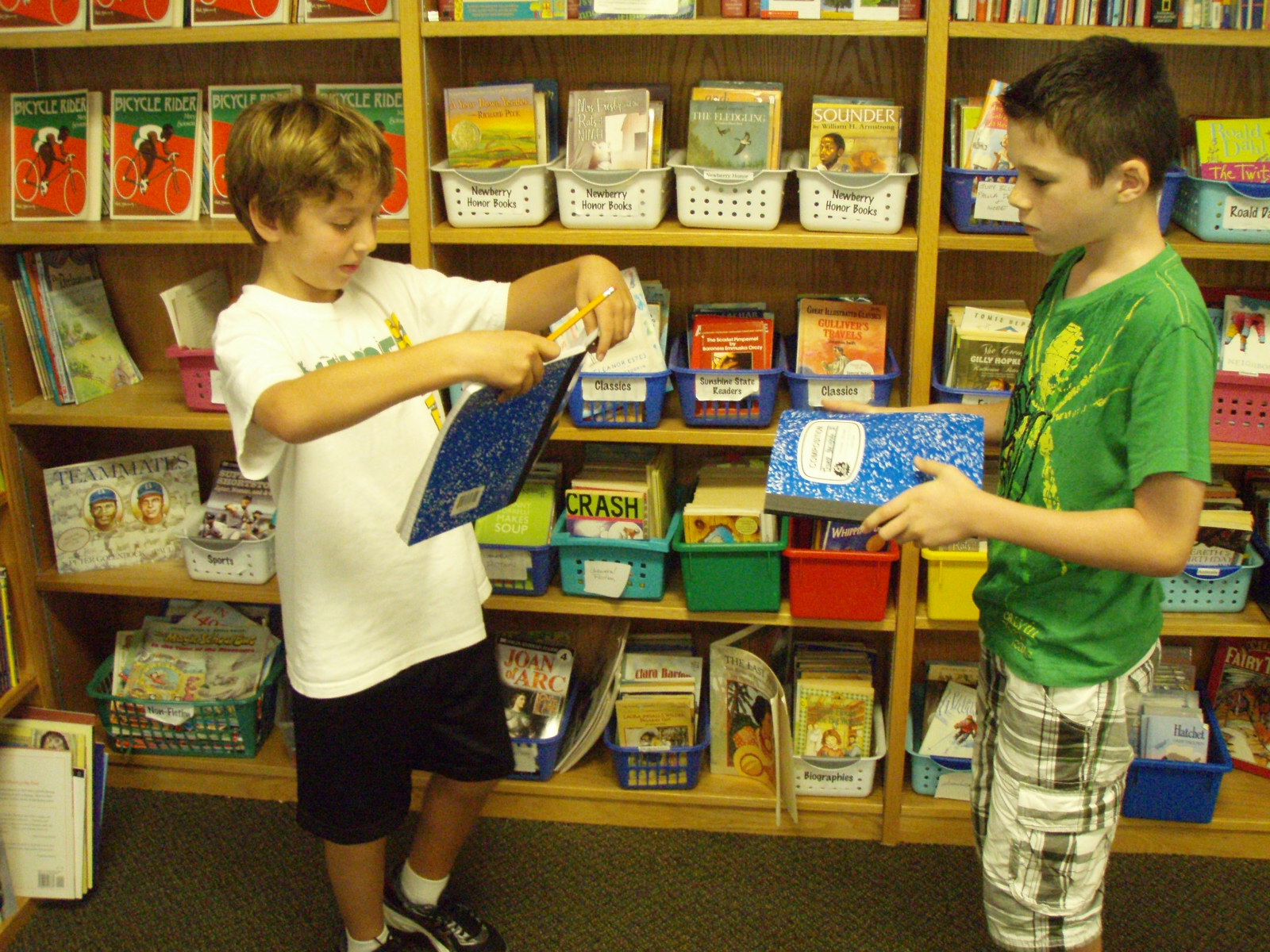
As you see from the photos below, students are already sharing with each other various things they've written. Writers read their latest efforts to one another. Each partner is expected to respond with positive encouragement and helpful hints.

Writers Workshop sets in motion a process of near daily writing experiences and lessons across the curriculum. Students will explore many genres of writing including: personal narrative, short fiction, persuasive essay, poetry, literary essay and historical fiction time permitting.

Writing sessions follow these steps. We begin with a mini lesson for the entire group in which I model (with my own writing or a piece of literature) something I want everyone to work on that period. Students write quietly at their desks for 20 to 3o minutes and frequently longer. During that time I move around and check on students progress and meet one on one with most. Later in the hour, students are encouraged to conference with their writing partners. These conferences feature each writer asking the other to explain what he or she is trying to accomplish with this particular piece of writing. This is when the helpful hints and encouragement are exchanged.

Students originally write in their journals. Second or third drafts are word processed and saved. Near the end of the process with any given piece of writing, students work from various checklists that assist them to improve their word choices, sentence variety, spelling, grammar, punctuation and voice.

Finally a piece is ready to be published. These final word processed pieces are analyzed by both student and teacher using the same rubric which has been specifically designed to evaluate each genre.

Sometime each trimester we hold a public reading/celebration in which our student-authors share their writings. These collected writings are "bound" in a permanent booklet with student designed cover art.

Students are working on several poems, a personal narrative and a piece of short fiction. They are also beginning to "journal" their reactions to the novel A Land Remembered which I am reading to them. This provides an introduction to an important first step in writing a literary essay.
Our writing year began with my wife giving an informal talk on her life as a writer. She shared her insight that all writers are readers, observers of human behavior and note takers.

Here's a list of the mini lessons the class has experienced thus far.
Writers are readers, observers and note takers
A writer’s life discussed
During Writer’s Workshop everyone writes and shares including the teacher.
Stories/writing ideas come from everywhere
Writing from a prompt: sticker story
Why writers cross out instead of erasing
Importance of sentence variety
Writer’s Workshop procedures reviewed
Writers read their writings to each other.
Writers compliment each other and offer helpful hints.
Writers ask, “What are you trying to do with this?”
Writers reflect on what: they’ve learned about, are pleased with and/or need to improve.
About conferencing with the teacher, editing and word processing
“The Important Book” poetry project
Introduction to praise poem (ode) writing: “an electrical device we can’t live without”
Literature helps us understand various genres of writing
Personal Narrative introduced: “TV and Me”
Brainstorming and listing possible first experiences or important small moments recalled
Difference between personal narrative and memoir
About “voice:” how to get your writing to “sound” like you…..(example: Connor’s personal narrative about remodeling his house.)
Special paragraphing when writing dialogue
Describing characters: add appearances, mannerisms and personality traits of people around you observe
Importance of planning (inspiration style webbing etc.) either before writing soon after starting; revising as you go along

Writers Workshop sets in motion a process of near daily writing experiences and lessons across the curriculum. Students will explore many genres of writing including: personal narrative, short fiction, persuasive essay, poetry, literary essay and historical fiction time permitting.

Writing sessions follow these steps. We begin with a mini lesson for the entire group in which I model (with my own writing or a piece of literature) something I want everyone to work on that period. Students write quietly at their desks for 20 to 3o minutes and frequently longer. During that time I move around and check on students progress and meet one on one with most. Later in the hour, students are encouraged to conference with their writing partners. These conferences feature each writer asking the other to explain what he or she is trying to accomplish with this particular piece of writing. This is when the helpful hints and encouragement are exchanged.

Students originally write in their journals. Second or third drafts are word processed and saved. Near the end of the process with any given piece of writing, students work from various checklists that assist them to improve their word choices, sentence variety, spelling, grammar, punctuation and voice.

Finally a piece is ready to be published. These final word processed pieces are analyzed by both student and teacher using the same rubric which has been specifically designed to evaluate each genre.

Sometime each trimester we hold a public reading/celebration in which our student-authors share their writings. These collected writings are "bound" in a permanent booklet with student designed cover art.

Students are working on several poems, a personal narrative and a piece of short fiction. They are also beginning to "journal" their reactions to the novel A Land Remembered which I am reading to them. This provides an introduction to an important first step in writing a literary essay.
Our writing year began with my wife giving an informal talk on her life as a writer. She shared her insight that all writers are readers, observers of human behavior and note takers.

Here's a list of the mini lessons the class has experienced thus far.
Writers are readers, observers and note takers
A writer’s life discussed
During Writer’s Workshop everyone writes and shares including the teacher.
Stories/writing ideas come from everywhere
Writing from a prompt: sticker story
Why writers cross out instead of erasing
Importance of sentence variety
Writer’s Workshop procedures reviewed
Writers read their writings to each other.
Writers compliment each other and offer helpful hints.
Writers ask, “What are you trying to do with this?”
Writers reflect on what: they’ve learned about, are pleased with and/or need to improve.
About conferencing with the teacher, editing and word processing
“The Important Book” poetry project
Introduction to praise poem (ode) writing: “an electrical device we can’t live without”
Literature helps us understand various genres of writing
Personal Narrative introduced: “TV and Me”
Brainstorming and listing possible first experiences or important small moments recalled
Difference between personal narrative and memoir
About “voice:” how to get your writing to “sound” like you…..(example: Connor’s personal narrative about remodeling his house.)
Special paragraphing when writing dialogue
Describing characters: add appearances, mannerisms and personality traits of people around you observe
Importance of planning (inspiration style webbing etc.) either before writing soon after starting; revising as you go along
Subscribe to:
Posts (Atom)